What Gets Passed On — Ian Caithness, Les Mason & the Lineage of Oh Boy Agency
Three Generations — 1946 to Now
In my mum's studio, a painting sits amongst her artworks. Executed in gouache on canvas board, its bold flat colours depict a surreal pencil-faced figure in a room that opens onto another world. On her bookshelves sits a magazine. The same image, reproduced on a cover. Graphis, issue 174, published in 1974 — the international design journal published in Zurich, where for decades the world's best graphic design was documented and shown.
The painting is an original by Les Mason — the man widely regarded as the father of Australian graphic design. My mum has had it her whole life. It came from her father.
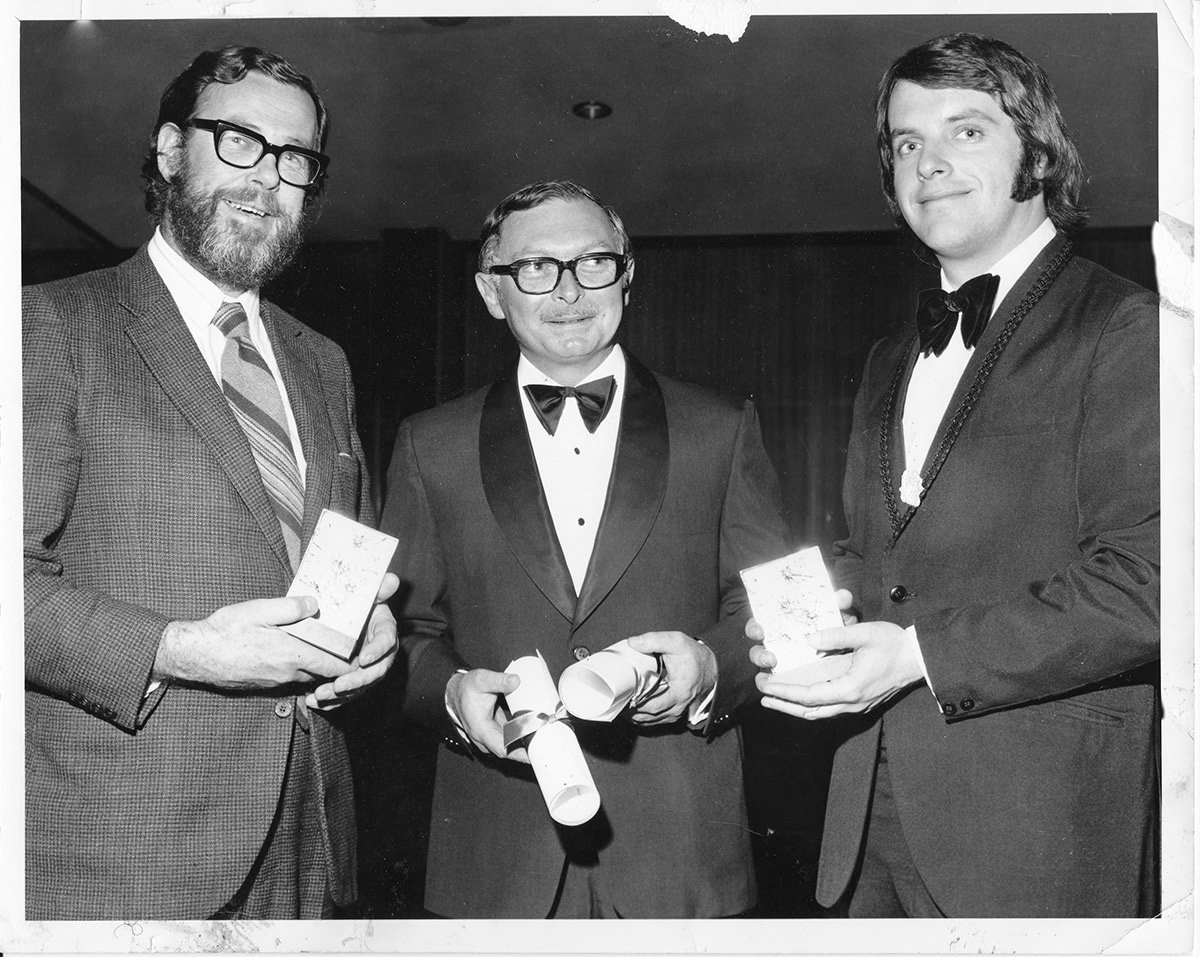
Ian Caithness, Left | Ad Awards
01 / Ian Stuart Caithness — The Creative Director Melbourne, 1946–1978
Ian didn't arrive in advertising from the business side. His CV, dated 26 February 1991 and typed from a property called 'Tipooburra' in Walwa, rural Victoria, lists his first role as Artist at K.M. Campbell Pty. Ltd., beginning 1946. Over nineteen years he moved from artist to copywriter to account service to director. By the time he arrived at Hayes Advertising in 1965, he had held every role the industry had.
Hayes Advertising Agency Pty. Ltd. 258 Little Bourke Street, Melbourne, Vic. 3000
35 employees across Melbourne & Sydney Billings: $2,444,000 (1971) —
approximately $37 million in today's Australian dollars
Board of Directors M. M. Court, Chairman · G. P. Hayes, Managing Director · K. L. Austin · I. S. Caithness · J. L. Crane · L. L. Mason
That last name. L. L. Mason. Les Mason. The Californian designer born in 1924 who opened his first studio in California in 1958 before leaving for Melbourne in 1961. He came with an established practice, not as an unknown. Designer Alex Stitt, writing in Meanjin in 2010, described Mason's visual language plainly: his work had a California look, like Paul Rand or Saul Bass. Rand designed the IBM logo. Bass designed the title sequences for Hitchcock and Preminger. The editors of Graphis described Mason, in their own issue 174, as "an American immigrant who has had a fructifying influence on Australian design." When he arrived, corporate design was virtually unheard of in Australia — packaging was still the province of printers. He would later be called the father of Australian graphic design.
In the same Meanjin interview, Stitt described how the relationship between Ian and Mason came about: Hayes Advertising had become a hot shop in the mid-sixties, and Ian managed to talk Mason into becoming their creative director. Mason had left his previous agency and started his own studio — so he was running his own enterprise simultaneously. His work appeared in both Graphis and Gebrauchsgraphik, its German equivalent published in Munich. Australian designers of that era rarely appeared in one. Mason appeared in both.
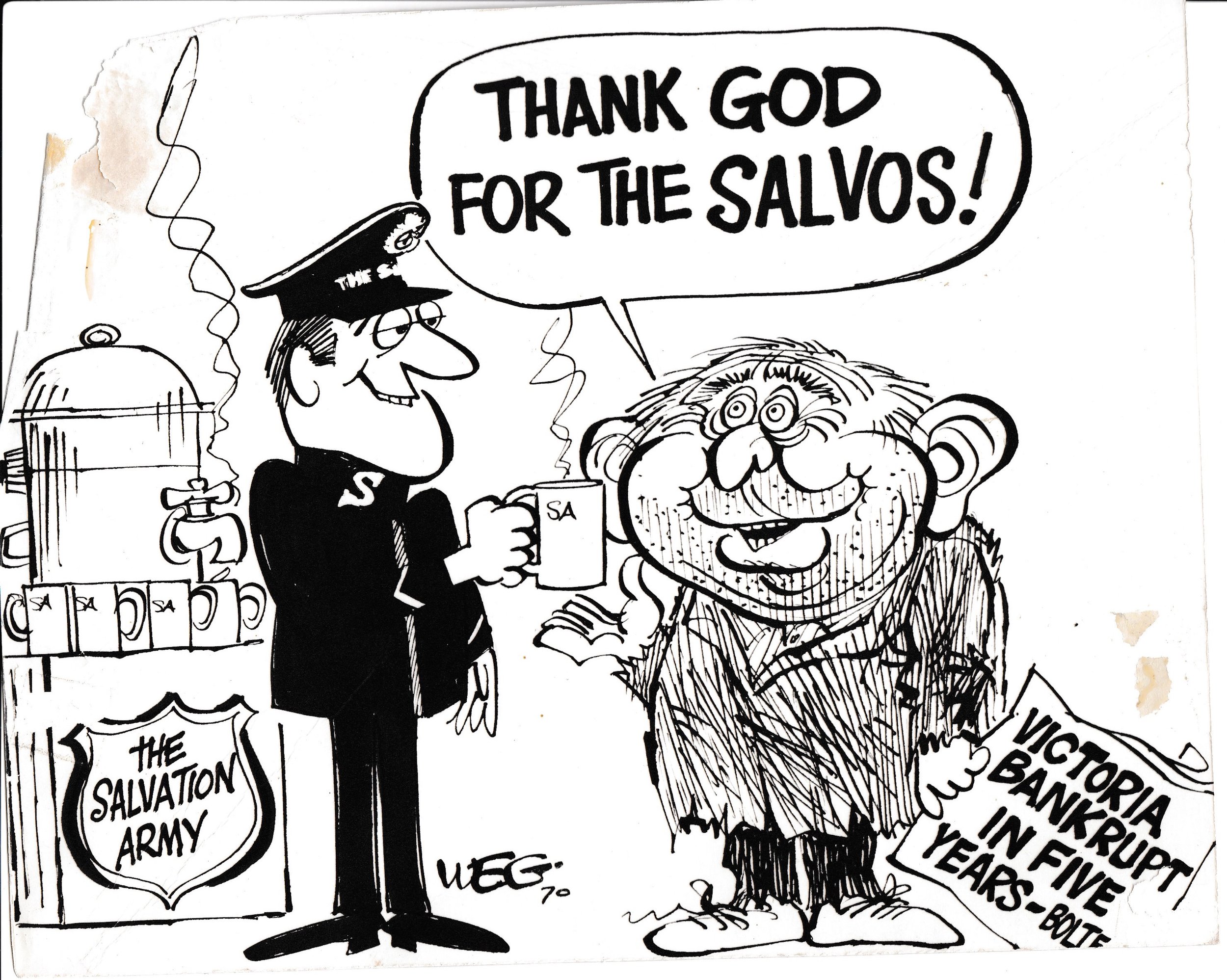
Campaign · 1969–1977 | The Salvation Army — National Red Shield Appeal
Listed in Hayes's own capabilities booklet under a single line: Honorary advertising agency. The work was done for nothing. Nearly a decade of raw, humanistic photography and copy that treated readers as intelligent adults. Headlines like "The old don't always eat alone" and "Which one is the mother?" The line that has endured ever since — still used today, over fifty years later — was coined by Ian and the team: Thank God for the Salvos. Artist Wes Walters, later an Archibald Prize winner, created the figure drawings that ran throughout the campaign. The President's Award was presented at the ADCM's annual dinner on 14 November 1974, at The Age Gallery, opened by the editor-in-chief of The Age, Graham Perkin. The award was shared by Hayes Advertising, Les Mason, Wes Walters, and Al Et Al — the studio of designer Alex Stitt.
President's Award Gold Medal · Art Directors Club of Melbourne · November 1974
Campaign · 1974 | Preservene Pure Soap — Television
The Preservene TV campaign won Gold in Category 3 Campaigns at the 1974 Art Directors Club of Melbourne. Art Director: Les Mason. Copywriter: Gail Scott. The director was Fred Schepisi — then a commercial director, years before The Chant of Jimmie Blacksmith, Roxanne or Six Degrees of Separation.
Gold Medal · Category 3 Campaigns (Television) · ADCM · November 1974
Installation · c. 1973 | National Gallery of Victoria — Building Site Fence
The corrugated fence surrounding the NGV building site on Melbourne's main thoroughfare, expected to stand for seven years during construction. Mason designed it to appear black and white from one direction and full colour from the other, forming complete compositions when viewed from right angles. A piece of public graphic design on one of Australia's busiest roads, produced through Hayes Advertising.
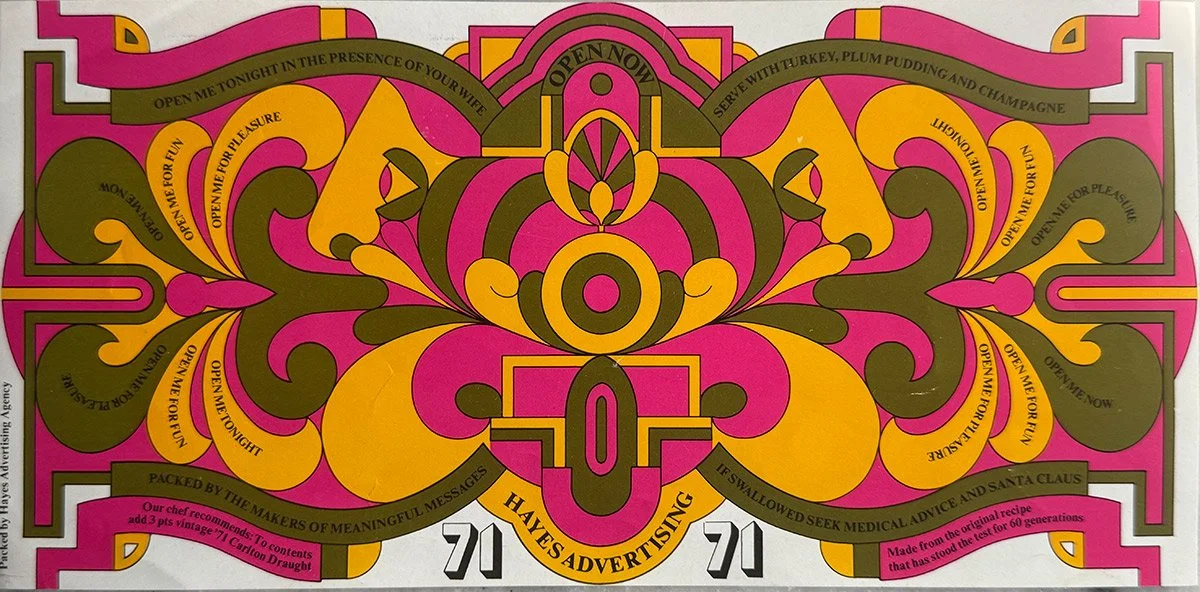
Other major accounts were Trusty and Buster — dog food brands produced by KMM Pty. Ltd. The Buster bag features bold geometric dogs in flat colour with thick black outlines — Mason's visual language applied to a grocery shelf. The original packaging mock-up is still in our family.
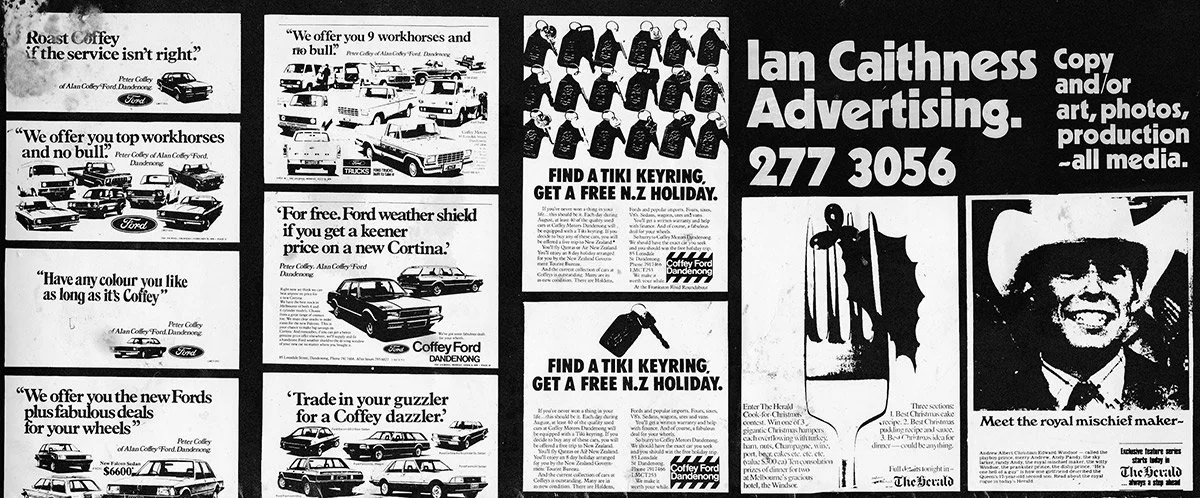
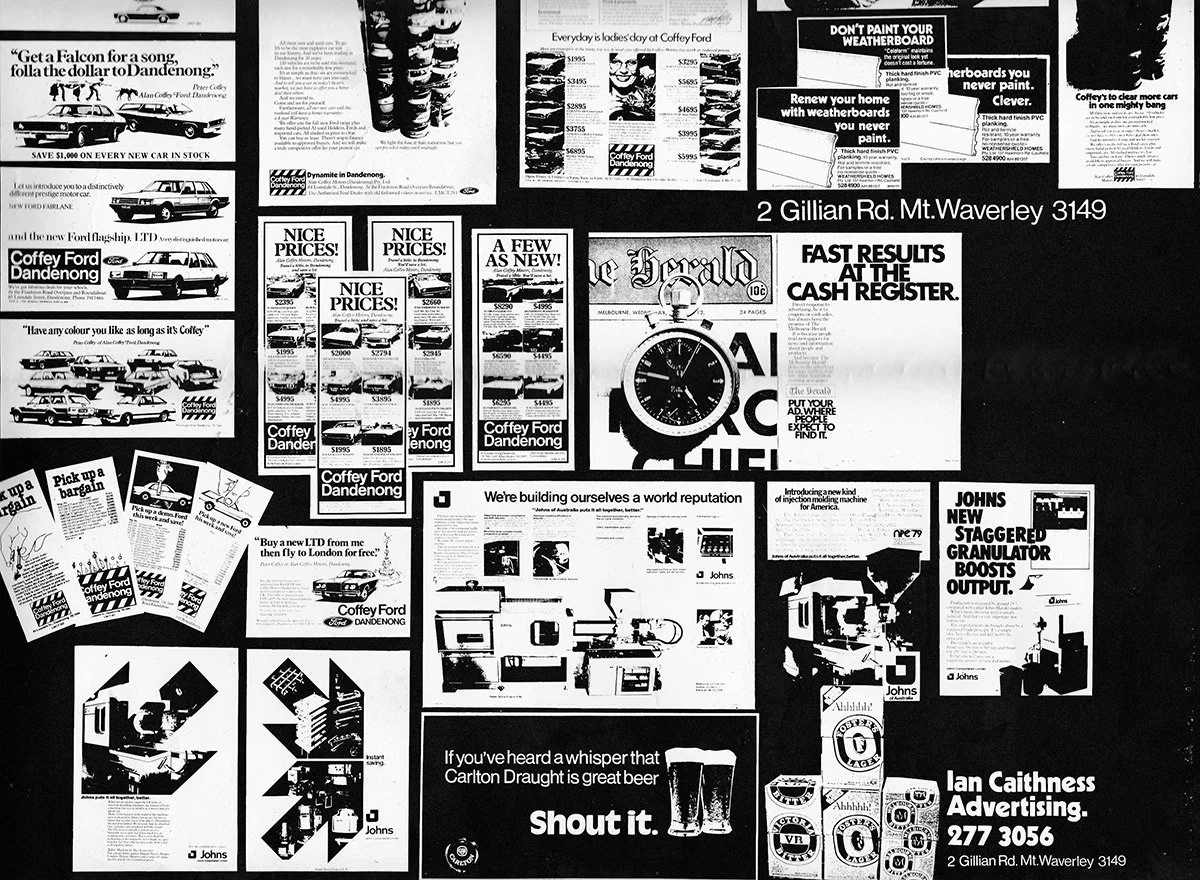
Ian Caithness — Career Timeline
1946–1965 · K.M. Campbell Pty. Ltd. — Artist. Copywriter. Account service. Director.
1965–1975 · Hayes Advertising Pty. Ltd. — Director. Creative Director. General Manager.
1975–1976 · Hayes Cowcher Dailey Pty. Ltd. — Director. Creative Director.
1976–1978 · George Patterson Pty. Ltd. — Special Projects. Herald & Weekly Times, CUB, Cadbury's.
1978 onward · Independent — 'Tipooburra', Walwa, Victoria.
He had the first computer in our family — an early Apple. Most people in his position would have used it for work correspondence. He used it to set type for birthday cards. Every year, whoever in the family had a birthday got a card he'd made himself — a considered typeface, a deliberate layout, proper care put into something that most people dash off in two minutes. I didn't know what typography was then. I just knew his cards looked different from everyone else's.
I think about that a lot now.
02 / Robyn Sweaney — The Painter Melbourne → Mullumbimby, 1957–Present
Ian's daughter grew up in Mount Waverley, in a flat-roofed modernist house designed by emigre architects Hogar & Holgar. Les Mason's artworks were on the walls. Graphis magazines were on the shelf. The original cover art for issue 174 was in the house. Her father was running the creative direction of one of Melbourne's significant advertising agencies through most of her childhood.
"Certain elements of place resonate an unexplainable reaction within me — something ignites deep within memory. The landscape is somehow opened up by the search itself and my response can reach beyond its visual appearance."
Robyn Sweaney has been a practising artist since 1992. She is represented by Arthouse Gallery in Sydney. Her work is held in public collections across Australia including the State Library of NSW, Artbank, HOTA, Tweed Regional Gallery, and the Margaret Olley Art Centre. She is a six-time finalist in the Wynne Prize, and won the Wynne Trustees' Watercolour Prize in 2019.
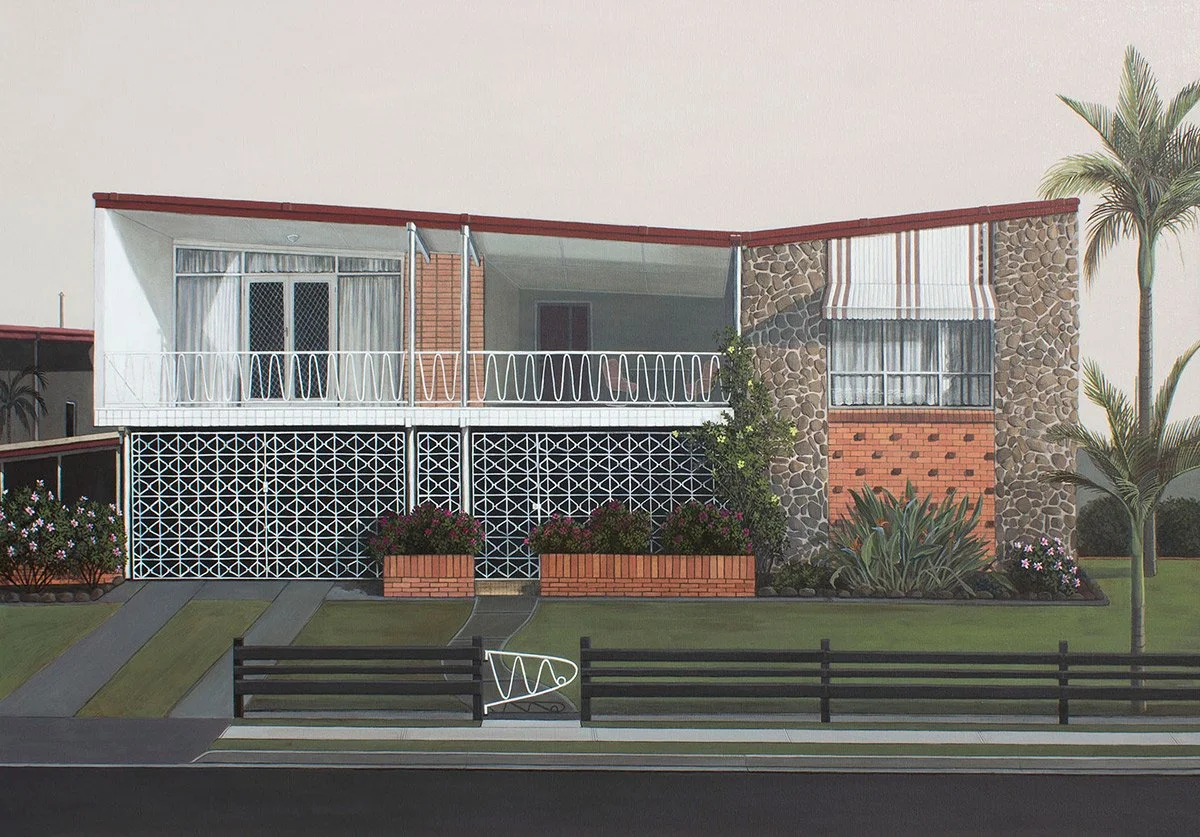
Paradise lost, 2022
Her practice is not obviously connected to her father's world, at least not on the surface. She paints houses. Modest post-war homes. Flat-roofed suburban dwellings. The built environment of mid-century Australia, precisely the era Ian spent his career advertising into.
The connection isn't literal. It's absorbed. She grew up in a household where visual thinking was serious, where design was a discipline, where the difference between considered and careless was apparent and mattered. That doesn't produce a graphic designer. It produces someone for whom looking carefully at how things are made, and what they mean, is simply how you move through the world.
Thirty-six years ago she moved to Mullumbimby.
03 / Oh Boy Agency — The Studio Mullumbimby (Bundjalung Country), Present
The artist portrait on Robyn Sweaney's page at Arthouse Gallery carries a single credit line: Photograph by Danny Sweaney, Oh Boy Agency.
Oh Boy Agency is based in Mullumbimby. We work in branding, product photography, and visual identity. The lineage is not something we trade on — it doesn't appear in proposals or pitch decks. But it shapes how we think about the work, what we think the work is for, and what we mean when we use the word considered.
This piece exists because of what's still in the studio: the original Mason painting, the Graphis 174 cover art, the Hayes capabilities booklet from 1971. And because those objects represent something that can't be manufactured — that serious creative practice is transmitted, not just taught.
Ian Stuart Caithness.
Artist. Copywriter. Creative Director. General Manager.
Robyn Sweaney.
Painter. Six-time Wynne finalist. His daughter.
Oh Boy Agency.
Still looking carefully.
Further reading & archive
The complete digital archive of Les Mason's work is held by DHARN — Design History Australia Research Network in partnership with the National Gallery of Victoria. All images © Les Mason Estate.Robyn Sweaney is represented by Arthouse Gallery, Sydney.
Primary sources: The Age, Melbourne (1969–1980); Graphis issue 174, article by Brian Sadgrove; "Life by Design: Sophie Cunningham talks to Alex Stitt," Meanjin, Winter 2010.